
Money in America: The Struggle for Restoration and After is a thesis on the American tradition of money-reform politics running throughout the American 19th c., its conditions, concepts and struggles, the contemptuous academic treatment it has been given in the 20th c., and the shape of the world since its exit from the American political scene, running up through the mechanics of the Eurodollar system of today’s world-monetary paradigm. To be clear, this tradition of money-reform politics strove to abolish banking, its debt-based money supply, and the corrosive economic dynamics to which we consign ourselves in accepting it.
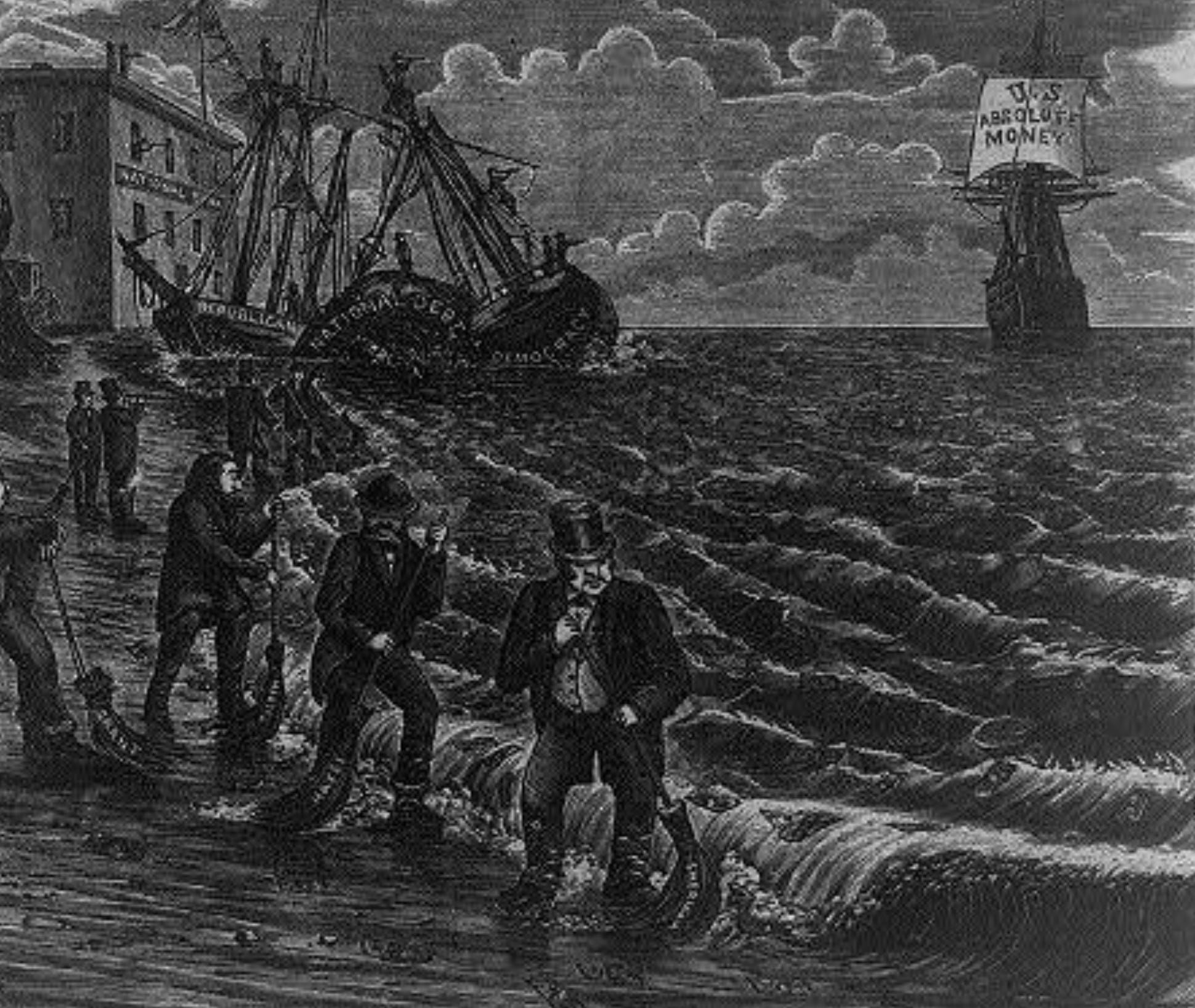
I know that this topic has been beaten to death many times, mainly in pamphlets and pulpy conspira-tainment texts, some better than others. The related problems are so fundamental and their solutions are so simple that academics scarcely ever condescended to touch them, and so they sank into the domain of the “low-brow.” Yet the problems are not only real but increasingly impossible to ignore. Worse, the dissident critics of banking seem not to have the courage of their own convictions, as they rarely attempt to discipline their works within a grounded historical and/or macroeconomic-analytical frame. If this is all real, why not treat it with the seriousness it merits? Why not situate a critique of banking within a rational framework of political economy?
I felt compelled to write this book by the coincidence of many reasons. A few of those reasons occur to me now as I’m writing this.
One is that an establishment Brain Trust is starting to appropriate the politics of serious monetary reform for themselves. By ‘monetary reform’ we are referring to the abolition of the system of bank-created debt-money and its replacement with sovereign-issued debt-free money. At a more peripheral level, ‘monetary reform’ also entails greater state supervision and direction over the banking system and the financial system at large. The problem here is that the politics of monetary reform is a tradition with roots running right back to the founding, and it belongs squarely to the Old America which is so reviled by academia today — it was never entirely on the ‘Progressive’ (in the contemporary sense of the word) side of history. To allow it to become resurrected as a partisan issue monopolized by establishment technocrats, who have revealed their commitment to exterminating the last traces of the Old America, would be one of the most humiliating and unnecessary intellectual failures in the entire history of the American people.
The champions of monetary reform, whom I call the ‘Restorationists’ in the book, and some of whom were known as ‘Greenbackers,’ were right about almost everything — they were accurate, however imprecise. But they were derided, infantilized and dismissed by the organs of official opinion for decades. Now, some 150 years later, as capitalism seems to be eating more seedcorn than it generates, a progressive consensus is forming in the establishment, acknowledging the validity of their thinking but not seeking to vindicate them historically or re-litigate the false charges laid against them. This area is simply too sensitive politically for a full accounting, and so the groundwork is being laid for Restoration without Restorationists and Greenbackism without Greenbackers.
As a second reason, and broadly speaking, right-populism and the right in general are ignorant of the principles of macroeconomics and monetary theory. This is particularly the case with monetary theory. Even as their guiding principles are daily challenged by unfolding realities, economic thinkers on the right make ad hoc adjustments to their positions while continuing to preserve all of the priors and assumptions that led them to their errors. The reason things turned out this way are complicated and would make for a whole nother book.
In the wake of the 2008 GFC, political conditions were ripe for reform but dissent against the monetary status quo yielded only patch-up legislation and cryptocurrency for consolation. Worse yet, the monetary mechanics of the GFC, Stimulus, QE1/2/3, etc. were poorly understood by the public, who were not disabused of mistaken notions by the monetary authorities. If the reader is unfamiliar with the term “rehypothecated collateral,” I encourage them to refrain from directing further complaint against “fiat money” or “money-printing” until after they’ve looked at the 2010s from a different angle (shown in the book) — they may be overlooking something hugely important. Without a shift in perspective on the past twenty years, monetarily speaking, we can’t begin to properly address the current predicaments.
A third, undergirding the prior two, is that this is our true heritage as Americans. We should’ve learned this story in school, but were not raised to properly carry the burden of freedom. Nobody really put it together into a cohesive and targeted (targeted being the key word here) narrative, even though all the pieces were laying there, waiting for someone to come along and click them together. Stephen Zarlenga’s book stands out as a prominent exception. How can this silence be explained? Much of what is today considered elementary monetary theory was taboo and bitterly contested for all of the 20th c., and so most 20th c. historians did not feel up to the task of writing a faithful history of American money-reform politics, as their more authoritative cousins in the Economics departments would (and did) reflexively label it nonsense, the mark of death for the professional academic.
As mentioned above, while this topic has been positively beaten to death in the world of conspira-tainment and samizdat pamphleteering, with the occasional academic treatment, not nearly enough has been done to treat it like a serious topic deserving of academic rigor. If we think it’s actually true, then why don’t we act like it by disciplining our analyses with macroeconomic theory? Why don’t we have models to compare economic dynamics under different monetary paradigms? And the differing implications for questions of international political economy? [1] That’s properly beyond my ability, but that’s what I’d like to see, and I’d like to think my book can nudge things in that direction in some way, however small, by tracing through the conflicts between money-center and money-periphery starting from the first US Dollars.
The macroeconomic grounding for Money in America is Post-Keynesian, which I think many people are coming to realize is what ought to be taught in the textbooks and university curricula. ‘Post-Keynesian’ is kind of an ill-fitting term because some of the economists remembered as ‘Post-Keynesian’ were actually contemporaries of Keynes himself and, what’s more, helped to shape his views, maybe more than he was ever willing to admit. Post-Keynesians were inspired by Marx, but they helped to rescue Marxian analysis from its native, non-monetary, Ricardian paradigm, paving the way for a complete economic science. These topics are developed in greater detail in the book, but we don’t need to get mired down in the arcana of economic thought here. The point I’m approaching is that Greenbackers had basically already achieved Post-Keynesian economic consciousness by the 1870s, even before either Marx or Keynes, and it took the academic economic profession about a half-century to start catching up with them. This was less a Herculean intellectual achievement, and more a reflection of the fact that Greenbackers were unenfeebled by the ideological blinkers that afflicted accepted economic thought since the late-18th c. We should give higher esteem to those who correctly intuited the full shape of macro-dynamics generations before the professional economists came around to it (and half-heartedly so). In following, we should also proceed to revise our understanding of American history accordingly.
Money in America is for anyone who is willing to focus on something long and is interested in political economy, American history, an explanation for the material conditions of the present, or the prospects for human freedom in the future. Literacy is fast disappearing in America, so please be one of those that can carry this tradition into the future.
If just one person reads it from cover to cover, I believe it will become a classic.
Get the link to order, or read the preface/intro/TOC here: https://miasfr.info
Notes:
[1] - It has arguably never been more important than it is now to be able to conceptualize of the world-economy in terms of the money-center/periphery financial relations as grounded on the institution of banking’s debt-money. The Restorationist tradition is uniquely well-suited to this task, as it recognized debt-money as an arbitrary paradigm that we could step out of any time we wanted to. As evidenced by the Brain Trusters’ moves toward developing a curriculum of greenbacker political economy, this realization is essential to navigating our current circumstances.
You used the phrases "center" and "periphery" in a way that reminded me of Eric Gans and Adam Katz's work. Is there any connection between your work and theirs?
Are you the same man behind Exiled Jargon on blogspot? A twitter user by the name of Jargon - who has a similar handle and name to an extinct handle @ Jargon_0 which was referenced in a threadreaderapp post offhand in one of three google results responsive to the name - constantly reposts you.